Tuesday, February 6, 2018

Volvo's Model 3-battling Polestar 2 will make a big appearance mid-2019

Volvo's Model 3-battling Polestar 2 will make a big appearance mid-2019

Regardless of the way that still especially in its beginning times, Volvo Cars' free Polestar check has colossal plans for what's to come. The Volvo S90-based Polestar 1 dispatches one year from now. It's a cross breed execution auto with 600 quality, of which only 500 will be developed each year. It's Polestar's brilliance auto. What comes after, regardless... that is for the larger part.

The ensuing model will be known as the Polestar 2, and it's depended upon to cost around $50,000 (about €40,000 in light of current exchange rates). It'll show up in mid-2019, awesome Polestar 1 hits the market. Also, remembering that the Polestar 1 roadster will be a little volume auto, Polestar is assessing around 60,000 arrangements consistently for the 2, extensively. Tending to Roadshow at Volvo's headquarters in Gothenburg, Sweden, Polestar Boss Thomas Ingenlath confirmed the 2 will be founded on a charged variation of Volvo's new Moderate Specific Designing (CMA). That is the phase that backings the association's new XC40 half breed. We can't tell you exactly what it'll look like, yet permits just say it's not a setback that we've demonstrated this story with photos of the Volvo's 2016 40.2 Thought.

Ingenlath says Volvo Cars' two new electric vehicle outlines will show up with Polestar models. "We will do this with CMA with Polestar 2." Past that, "[Polestar] will do this with the electric building of SPA 2," he says. "This will be the Polestar 3 conveying this first into the market."

Really, Polestar 3. A vehicle coming a few years after Polestar 2, this third model will use another (and charged) version of the SPA disengaged organize. We can't uncover to you what no doubt, yet considering the present SPA designing backings the S90, V90 and XC90, that should give you an unpalatable idea of its general size.

"Everything around electro-adaptability will be initiated inside Polestar," Ingenlath says.

For now, our first taste of Polestar's electro-adaptable, tip top future gets in contact one year from now. The Polestar 1 uses a changed variation of the S90 T8's twin-engine blend powerplant, yet with several electric motors mounted at the back turn, each of which drives a person back wheel. Regardless, Ingenlath promises us, Polestar isn't just an EV arm for parent association Volvo.


"It's not just about changing a tuner check that we had into, you know, something that we stick now under our electric Volvos," Ingenlath says. "They're not just electric Volvos. They stay for an option that is other than what's normal."

Monday, February 5, 2018

Hyundai Ioniq to be Showcased in India in All-electric,Plug-in, Hybrid, Avatars:Vehicle Expo 2018

Hyundai Ioniq to be Showcased in India in  All-electric,Plug-in, Hybrid, Avatars:Vehicle Expo 2018

South Korean carmaker Hyundai is ringing in its twentieth remembrance of creation and arrangements in the country at the Vehicle Expo 2018 in Delhi. Moreover, it is in like manner using the phase to show off what could be its future bearing in India. Besides, taking a prime spot in its show will be the trio of Hyundai Ioniq autos. The Ioniq will visit on any similarity of the Honda Accord Half and half, Toyota Camry Mixture and the Toyota Prius, close by the different electric vehicle models coming up and to be displayed at the Expo. Hyundai will want to bring the Ioniq into India by methods for the CKD course and accumulate it locally to hold costs under tight limitations and esteem the auto powerfully. Moreover READ: New Hyundai i20 First class to Dispatch at Automobile Expo 2018

The earth welcoming vehicle, which is at this moment the only a solitary on the planet that comes in each one of the three non-non-sustainable power source chugging shapes, is available in three varieties: cream, module cross breed and electric. Furthermore, remembering that there is to a lesser degree a plausibility for each of the three interpretations to land on Indian shores, it is more likely shape the Ioniq Half breed to go to the country. Furthermore, Hyundai won't procure the auto as a CBU, which would scale import costs and, in this manner, the cost of the auto.

YK Koo, regulating head of Hyundai Engine India, has recently said that restricting making of automobiles and their fragments is the course ahead to making blends down to earth and accordingly productive in India. Hyundai may would like to esteem the green auto at around INR 25 lakh to INR 30 lakh, which should enable set it to well against the Honda Accord Half and half and the Toyota Camry Mixture. Hyundai envisions that it could offer around 100 units consistently with that assessing, which is a ton considering how energetic the EV grandstand in India is.
Hyundai Kona to be shown at Vehicle Expo 2018


The Hyundai Ioniq saw the light of day in 2016, at the car expos in New York and Geneva. After it was moved, the Ioniq sold more than 31,000 units in its first year. Supporting the auto is a 1.6-liter, four-barrel, Atkinson cycle Kappa engine that can pass on around 103 bhp of vitality and 148 Nm of torque. The engine is joined with a twofold hold, six-speed transmission and an electric motor that can deliver a similarity 32 bhp of vitality and 169 Nm of torque. A lithium-molecule polymer hitter of 1.6 kWh restrain fills the electric motor.

181,797 cars will be recalled by Toyota in China

181,797 cars will be recalled by Toyota  in China

The review was documented by GAC Toyota Motor and Tianjin FAW Toyota Motor to the General Administration of Quality Supervision, Inspection and Quarantine, a news office detailed.

Toyota will review 181,797 vehicles over an airbag imperfection in China.

The review was documented by GAC Toyota Motor and Tianjin FAW Toyota Motor to the General Administration of Quality Supervision, Inspection and Quarantine (AQSIQ), Xinhua news office revealed.

Beginning February 10, the organization will review 73,084 New Highlander vehicles fabricated between May 5, 2015 and February 4, 2016, and 98,218 Levin models created between May 4, 2015 and February 4, 2016, and also 5,804 Levin half and half autos delivered between October 11, 2015 and February 4, 2016, as per the AQSIQ.

Likewise Read: Toyota offers 1.52 mn e-vehicles in 2017, three years in front of 2020 target

The review likewise incorporates 4,691 Corolla crossover autos fabricated by Tianjin FAW Toyota Motor between November 21, 2015 and February 2, 2016.

There are worries that imperfect quickening transducer parts in the airbags of influenced vehicles may cause air packs to glitch, which could represent a danger to wellbeing, as indicated by the announcement.


Toyota would trade the flawed parts for influenced auto proprietors for nothing.

Saturday, February 3, 2018

Maruti Suzuki To Exhibit Hybrid Autos At Automobile Expo 2018

Hybrid models of the new Swift and Solio, which are as of now at a bargain in Japan, could show up at the Auto Expo 2018

It's legitimate. Maruti Suzuki will grandstand its half breed innovation at the forthcoming Auto Expo 2018. Suzuki, Maruti Suzuki's parent organization, as of now offers two mixture vehicles in Japan - the Swift Hybrid and the Solio Hybrid. Since these are solid half breeds, they're fit for covering short separations utilizing an engine battery setup like ordinary electric vehicles. We're anticipating that Maruti Suzuki should feature no less than one of these autos, if not both, at the expo.

Maruti Suzuki says that half and half innovation can possibly quicken the jolt of powertrains in India. It could be a clue that India's greatest carmaker is soon wanting to dispatch a (solid) cross breed vehicle in the nation. Wish to know how a solid crossover vehicle like the Swift Hybrid sold in Japan is not the same as a mellow half breed vehicle like the Ciaz and the Ertiga diesel with SHVS? Read this. You can likewise separate a solid half breed Suzuki from a gentle crossover one by taking a gander at the 'Mixture' identification on both the vehicles. Check the picture underneath to realize what's extraordinary.

Suzuki Swift Hybrid 

The Japan-spec Suzuki Swift Hybrid is controlled by a 1242cc petroleum motor that creates a most extreme energy of 91PS and is matched with a 5-speed AGS (AMT). This motor, codenamed K12C, is unique in relation to the 1197cc K12B motor that makes a most extreme energy of 83PS and forces the Swift 2018 petroleum in India. Notwithstanding the 91PS motor, the Swift Hybrid's electric engine makes a most extreme energy of 13.6PS. The crossover hatchback restores a guaranteed fuel productivity of 32kmpl (in Japan) while the new India-spec Swift oil is asserted to convey 22kmpl.

Suzuki propelled the Solio Hybrid in late 2016. It is controlled by a similar motor engine blend as the Swift Hybrid and the guaranteed fuel effectiveness is likewise the same at 32kmpl. The Solio is a tall hatchback went for those searching for a functional vehicle on a financial plan. It's greater than the WagonR in all regards and is all the more effective as well.

Maruti Suzuki is yet to report its crossover auto anticipate the Indian market. In any case, we anticipating that the carmaker should open up about it at the up and coming Auto Expo 2018. 

Wednesday, December 6, 2017

Toyota Prius 20th Anniversary

 December 10th , 2017-  Will be marked as the 20th anniversary of The Toyota Prius, the world's first mass-produced hybrid vehicle (HV)
Consisting of a gasoline engine and an electric motor, the fuel-efficient Prius has been successful in opening up the global eco-car market. However, as countries across the world start to switch their attention to electric vehicles (EV), Toyota Motor Corp. is poised to use the electric and battery technology acquired through developing its HVs to deliver in the EV market as well.
"We made it in time for the 21st century." It was slogans like this that were bandied around by Toyota when it launched the Prius back in 1997, having started development on it in 1994. The new-type Prius offered about twice as much fuel efficiency as Toyota's mainstay model, the Toyota Corolla -- at 28 kilometers per liter. As global awareness about the environment increased, the Prius's extraordinary fuel efficiency attracted widespread attention.
Aided by a steep rise in gasoline prices, sales of the Prius surged considerably following the launches of the second-generation and third-generation Prius models in 2003 and 2009, respectively. The fourth-generation Prius, which was released in 2015, boasts a fuel efficiency of 40.8 kilometers per liter, helping cumulative sales of the Prius reach 4.15 million units as of late October 2017.
To date, Toyota has launched 37 types of HV including the Prius in at least 90 countries across the globe. Cumulative sales of all types of HV hit 11.22 million by the end of October 2017. Furthermore, Toyota's electric cars including EVs made up for over 40 percent of the world market share in 2016. "We have succeeded in creating a new set of values," said Toyota Chairman Takeshi Uchiyamada, who oversaw the development of the first-generation Prius.
However, there has also been a recent backlash against HVs, as a result of EVs receiving preferential treatment over HVs under environmental regulations in western countries, China, India and elsewhere. This is why major auto firms across the world are beginning to concentrate more on developing EVs.
Recently, Toyota has placed emphasis on plug-in hybrid vehicles (PHV) that can be charged at home, as well as fuel cell vehicles (FCV). However, it has yet to produce EVs on a mass scale, which is a stance that has drawn criticism.
At a briefing aimed at the media in late November, Shizuo Abe, an executive general manager at Toyota, said, "Since launching HVs 20 years ago, we have succeeded in making auto components such as motors smaller, and increasing performance. We have even shown superiority in terms of electric car manufacturing technology."
Looking ahead, Toyota aims to use the technology developed from making HVs to produce an EV that can be mass produced in China in 2020. It also aims to develop a solid-state battery system for EVs by the first half of the 2020s.
In September, Toyota teamed up with Mazda Motor Corp. and Denso Corp. to set up a new company that will develop essential EV technology, with the aim of strengthening its commitment to EV development. However, some are worried about the potential of EVs. "Will EVs really take off, considering that they are inferior to HVs in terms of price and range?" a senior Toyota executive says.
So, will Toyota be able to keep maintaining and developing its environmentally friendly image that was built up by the Prius? Questions such as this, as well as the firm's capability to adopt a flexible approach and respond to changes in the market, will no doubt come under scrutiny.

Thursday, February 12, 2015

Toyota Reveals Refreshed 2016 Avalon Including Hybrid Version

Toyota Reveals Refreshed 2016 Avalon Including Hybrid Version


Today Toyota unveiled its midcycle refresh of its Avalon including the hybrid version.
Unwrapped at the Chicago Auto Show, the fourth-generation vehicle that was all-new in 2013 gets styling updates while leaving powertrain intact.
Under the hood of the hybrids is A 2.5-liter Atkinson cycle four-cylinder engine paired with electric drive netting 200 horsepower. Efficiency is 40 mpg combined which compares favorably to V6 models netting 24 combined.


New for the 2016 Avalon is a retuned suspension, new LED headlights and tail lights, more convenience features, and of course, the latest look.
The Avalon Hybrid comes in five grades of V6 and hybrids come in three separate grades, from XLE Plus to XLE Premium and Limited.

 All models get wider lower front grille with narrow upper grille, new turn signals (replacing fog lights), chrome rear bumper accent, and gray accent stitching with light gray interior.
New standard features on XLE and XLE Plus grades include redesigned 17-inch alloy wheels, 7-inch Entune Audio Plus screen, woodgrain dash trim, and a Tire Pressure Monitoring System (TPMS).
Technology upgrades for the XLE Premium include Entune Premium Audio with Navigation and App Suite and the Qi Wireless Charging as standard.
The “performance-tuned” Avalon Touring adds to its sporty styling and standard are new 18-inch dark gray painted alloy wheels, sporty front fascia, new LED headlights with LED Daytime Running Lights (DRL), and a “Touring” badge.

The vehicle comes with a host of electronic safety including radar assisted crios and blind spot detecton.
It shares characteristics with the Lexus ES 300h, and it and the Camry Hybrid all share variations of the same hybrid powertrain.
Pricing was not announced but will be closer to release later this year or the fall.


Monday, February 9, 2015

Audi A3 Sportback e-Tron Plug-in Hybrid: Best Buy For Holding Value Over Time?

Audi A3 Sportback e-Tron Plug-in Hybrid: Best Buy For Holding Value Over Time? 

 When it comes to residual values for new cars, finance companies and buyers alike have been particularly cautious about all-electric and plug-in hybrid cars. Relatively new to the market, most plug-in cars are purposely given low residual value predictions by market research firms unsure of both the long-term outlook for plug-in vehicles and (generally unfounded) worries that a car’s expensive lithium-ion battery pack may lose capacity and therefore useful range.


Even though residual value predictions have improved for electric and plug-in hybrid cars over the last four years, they’re still generally low, resulting in high lease payments and/or higher interest rates for customers wanting to make the switch. And while some cars — like the Tesla Model S for example — now come with guaranteed resale values, newer models with longer-range capabilities mean that plug-in cars aren’t retaining their value.
But now German automotive magazine Auto Bild and market research institute Schwacke have proclaimed that Audi’s A3 Sportback e-tron plug-in hybrid is the current model year compact car most likely to retain its value over the next four years. This accolade has earned it the 2015 Wertmeister — or ‘Value Champ’ award in the compact car segment in Auto Bild’s annual residual value survey.
With a predicted residual value of 57.3 percent four years after purchase, the Audi A3 Sportback e-tron beats off plenty of other competitors in the compact car segment, both plug-in and non plug-in. In total, more than 40 different cars from 14 different automakers were considered across 15 different categories.
Based on the same Volkswagen MQB platform as the rest of the 2015 Audi A3 and 2015 Volkswagen Golf family, the Audi A3 Sportback e-tron features the same plug-in hybrid drivetrain found in the Volkswagen Golf GTE.


That equates to a 1.4-litre turbocharged four-cylinder gasoline engine mated with a hefty 80 kilowatt electric motor and a six-speed s-tronic dual clutch gearbox. Combined, the car is capable of producing 204 brake horsepower and 256 pound feet of torque, and can accelerate from 0-62 mph in 7.6 seconds on its way to an electronically-limited top speed of 137.9 mph.
Married with an 8.8 kilowatt-hour lithium-on battery pack, the Audi A3 Sportback e-tron can also drive on electricity alone, managing around 30 miles in electric mode at sensible speeds (less at higher speeds) before needing to fire up its engine. Recharging takes two hours from a standard Type 2/Level 2 charging station capable of providing 3.3 kilowatts.
It’s this all-round capability which seems to have won the day for Audi in terms of residual value. While it has an electric battery pack to allow for electric-only operation, the Audi A3 e-tron’s gasoline engine means it can still be driven even if the on-board battery pack isn’t capable of the 30-mile range it could when new after four years of hard driving.
In the past few years, we’ve noticed a similar trend among other plug-in cars: electric cars like the Nissan LEAF seem to suffer the highest depreciation, while plug-in hybrid models are less likely to sting the original buyer after a few years of use.
In the case of the Audi A3 Sportback e-tron however, its performance edge, everyday practicality, normal-looks, luxury name badge and high fuel efficiency are  enough to ensure that it beats many more quirky plug-in cars.
So if you’re looking to buy a plug-in car that will keep its value, perhaps you need to think about an A3 e-tron too.

Toyota Europe Aiming For 100 Percent Hybrid Battery Recycling

Toyota Europe Aiming For 100 Percent Hybrid Battery Recycling

Toyota’s hybrid vehicle battery life tends to be a lengthy one and the automaker is stepping up its efforts to recycle them.
The hybrid batteries used in Toyota and Lexus models can last longer the vehicles themselves, so often they are only recovered when the cars reach the end of their useful life, or if they have been involved in an accident.
Toyota already has a battery collection rate of more than 90 percent, but said it is now widening its strategy and targeting a 100 percent recuperation result.
The company stated in Europe, Toyota and Lexus dealers receive a new hybrid battery in exchange for an old one, leading to an average 91 percent collection rate.


Toyota Motor Europe (TME) has set itself the challenge to increase this figure to 100 percent, through its own network and, additionally, through any authorized end-of-life vehicle treatment operators.
To support this, the company has announced an extension of its current battery recycling agreements until March 31, 2018.
Since July 2011, the France-based Société Nouvelle d’Affinage des Métaux (SNAM) has been recycling nickel-metal hydride (NiMh) batteries, as used in the Prius, Auris Hybrid, Yaris Hybrid and all Lexus hybrid models.
Additionally, since August 2012, Umicore NV, based in Belgium, has handled lithium-ion (Li-ion) batteries, which are used in the Prius+ and Prius Plug-in models.
“When our customers buy a hybrid, they already know that they are in for outstanding fuel efficiency, a stress-free driving experience and a reliable car,” said Steve Hope, Toyota Motor Europe General Manager Environment Affairs. “This is yet another reason for a hybrid purchase, as we can ensure their car excels in its environmental performance throughout its lifecycle.”
Used hybrid batteries are still mainly destined for recycling, added Toyota, but TME has started to research options for the remanufacture of NiMh batteries, potentially giving them a second life as a vehicle or a stationary energy source.
Stationary batteries can potentially store surplus renewable energy, for example as an emergency back-up, or cheaper, or help manage fuel costs by storing cheaper, off-peak electricity

Monday, August 25, 2014

2015 VW e-Golf On Sale In November At $36,265


2015 VW e-Golf On Sale In November At $36,265


Today Volkswagen announced its first U.S.-market all-electric car will start at $36,265 including $820 destination when it goes on sale in November.
The e-Golf SEL Premium is being positoned as a “fully equipped” competitor to N
issan’s Leaf albeit sold in selected U.S. markets for now. Volkswagen hasn’t published the specific states, but company spokesman Mark Gillies said today it will be the states that follow California’s Zero Emissions Vehicle rules with an eye for market expansion in time.
We’ve seen early reports stating range at 115 miles positioning it as the highest next to a Tesla Model S, but Volkswagen says the car is capable of 70-90 miles “depending on driving style and charging behavior.” Gillies said he has under normal driving seen 105 miles himself, but VW is stating 70-90. Otherwise EPA data including MPGe is not yet ready for publishing, he said.


Power to the front-wheel-drive compact built on the Modular Transverse Matrix (MQB) platform is from a 115-horsepower, 199 pounds-feet electric motor and routed via 1-speed transmission. Top speed is 87 mph and three energy usage modes are Normal, Eco, and Eco+.


 Power to the front-wheel-drive compact built on the Modular Transverse Matrix (MQB) platform is from a 115-horsepower, 199 pounds-feet electric motor and routed via 1-speed transmission. Top speed is 87 mph and three energy usage modes are Normal, Eco, and Eco+.

Battery pack size at 24.2 kwh is very close to the Leaf’s 24 kwh. It’s built in-house at VW’s Braunschweig facility and includes a 7.2-kw onboard charger as standard.
It’s also equipped to handle DC quick charging by way of a “Combined Charging System” (CCS) that puts 80-percent charge back in under 30 minutes.
The battery, like the Leaf’s, is not liquid cooled. When asked whether VW was setting itself up for issues as Nissan had experienced a couple years ago, Gillies said the li-ion battery is engineered to be gently charged and discharged, and sent a statement from the comapny’s German engineers.

 To keep operating temperatures at ideal levels, VW has developed a Battery Management Unit with intelligent thermal control that allows the pack to remain within an optimal temperature range, helping to maintain performance and range in a variety of temperatures. This innovative system allows the e-Golf to operate in its intended manner, even in more extreme temperatures, without the need of a cooling system.

With a primary focus on efficiency rather than charge-time or capacity (like some of our competitors), VW was able to design a battery pack and utilize battery chemistry for the lithium ion cells (provided by Panasonic), that make the e-Golf one of the most efficient EVs on the market. As the battery system is so efficient, minimal waste heat is created during operation (i.e. during fast charging), which is quickly directed by the battery metal structure into the chassis, away from the battery, preventing extreme temperature conditions inside the pack. The lithium-ion cells being used, referred to as “marathon cells” by our engineers, are designed for gentle charge and de-charge thereby reducing heat and excessive energy consumption often associated with cells designed for rapid charging and de-charging. The elimination of the cooling system also allows VW to keep the weight of the battery pack down, which aides in overall efficiency of the vehicle.
The set up employed for the e-Golf has passed various long-term engineering evaluation milestones in desert temperatures and cold weather climates without the necessity of a cooling system.

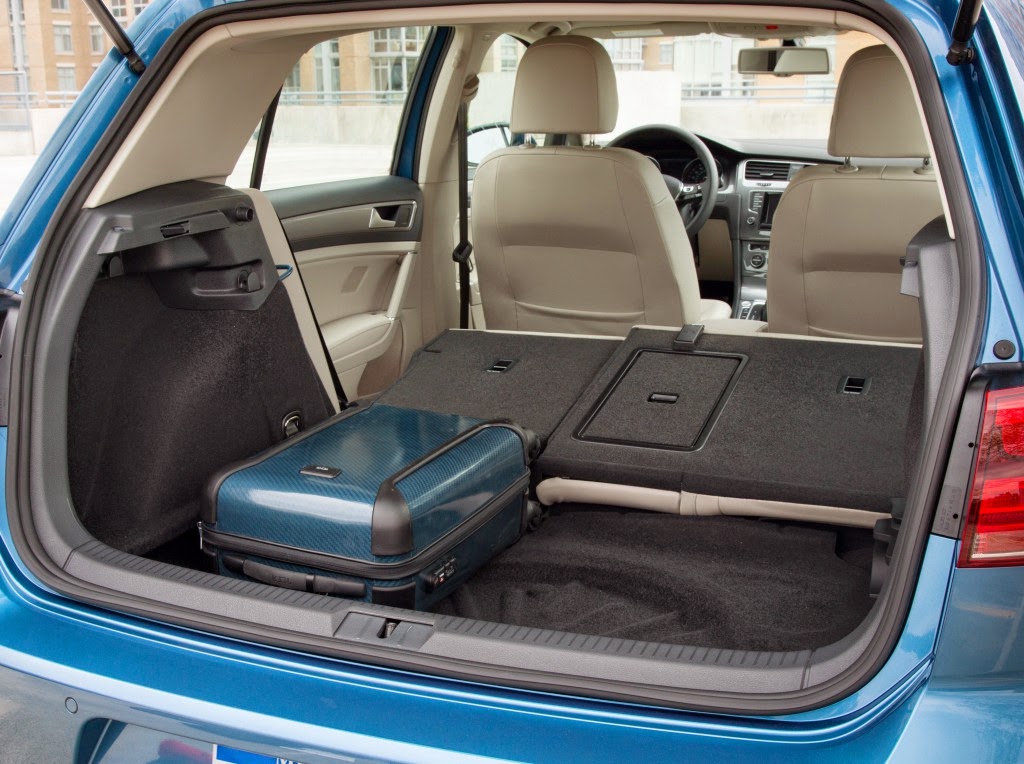
Interior volume is close to the Leaf also. VW says the e-Golf will match the regular Golf line with 93.5 cubic feet of total interior volume. The Leaf has 92.4 cubic feet. Cargo volume for the e-Golf is listed at 22.8 cubic feet. Leaf has 23.6 cubic feet.
The entry level Leaf S also starts at a lower price point in the $30,000 range. The Golf is relatively better equipped and positioned above this, and a closer match for the upper level Leaf’s.
Gillies said he has already been explicitly asked whether the e-Golf is a compliance car, and he said it’s really not. Volkswagen has designed the e-golf on a global platform as a global seller. For now, it is selling where compliance cars are selling, but the plan is not to stay only there forever.
Volkswagen is taking a wait and see approach, and did not state a specific roll-out plan beyond ZEV states, but that it is preparing for more growth in the electrification of the automobile is more certain. The e-Golf is the first, and assuming market acceptance, it’s implied the vehicle will eventually be made more widely available in the U.S. Gillies said also VW will in time offer more than just the fully packed version as now being launched.


He also emphasized the driving experience and utility will compare favorably with a regular Golf.
Upper level features standard with the e-Golf include:
• Three driver-selectable regenerative braking levels
• 5.8-inch touchscreen navigation system and infotainment center
• Bluetooth® technology
• SiriusXM® Satellite Radio
• Automatic Post-Collision Braking system
• Leather-wrapped multifunction steering wheel
• Dual-zone automatic climate control
• LED headlights
• Bespoke 16-inch aluminum-alloy wheels
• Keyless access
• Heatable front seats
• Rearview camera; and front and rear Park Distance Control
Volkswagen has also announced a “holistic”
approach to offset carbon emissions in an effort to let e-Golf claim carbon neutrality.


 2015 VW e-Golf On Sale In November At $36,265


Friday, January 3, 2014

Hybrid Car Displays Sun-Tracking Technology- Ford Solar

Ford's new concept for solar-powered hybrid car can run for 21 electric-only miles on a day's worth of sunlight. That possibility comes courtesy of sun-tracking software that works in combination with a concentrator lens to focus the sunlight falling on the car's rooftop solar panels.

The C-MAX Solar Energi Concept car—a modified C-MAX plug-in hybrid—won't achieve the dream of driving forever on sunshine just yet. But Ford's clever use of a concentrating lens does provide an inkling of new hope for solar power to someday become viable in hybrid or all-electric vehicles. Until now, solar power's energy density problem has limited its use in commercial vehicles to not much beyond a symbolic rooftop solar panel that runs a cooling fan for Toyota's Prius hybrid car.

Ford envisions its concept car parking beneath a tall carport with a roof made of a Fresnel lens—a lens originally developed for lighthouses that acts similar to a magnifying glass. The car company enlisted the help of Georgia Institute of Technology researchers to come up with the carport's sunlight-concentrating design.
The car's software would track the sun's path across the sky on any given day of the year and direct the car to move beneath the carport so that it continually receives the full impact of concentrated sunlight, according to Technology Review. That novel concept eliminates the need for an expensive tracking system that would change the angle of the carport's lens to keep sunlight focused on an immobile car's rooftop solar panels. (The concept car also has a traditional charging port so that it can plug into the power grid if needed.)
Such concentrated sunlight could reach 8 times the amount of sunshine that would typically fall on the C-MAX Solar Energi's rooftop. A day's worth of charging in the sun—about 8 kilowatts over four hours—would go into the lithium-ion battery that provides the 21 electric-only miles in the car's total range of 620 miles. Ford estimates suggest the
C-MAX Solar Energi Concept would have the same total range on a full charge as compared to the conventional C-MAX Energi.
The U.S. automaker has big plans for its concept car following a debut at the 2014 Consumer Electronics Show, 7-10 January in Las Vegas. Ford will work with Georgia Tech to begin testing the vehicle in "real-world scenarios" and see whether its concept can prove practical in everyday life—a challenge that may yet pose some headaches. For instance, Toyota's engineers previously found that connecting rooftop solar panels to the battery of a Prius created an antenna-like effect that interfered with the car's radio.
Most car companies have settled for slightly less ambitious goals involving the use of solar power. Tesla Motors has opted for solar-powered charging stations that keep the solar panels off the roofs of its sleek vehicles.
Still, the benefits of a solar hybrid vehicle could prove worthwhile in the long run. Ford says its internal data already suggests sunlight could power up to 75 percent of the trips made by an average driver in a solar hybrid vehicle. And the C-MAX Solar Energi could also slash greenhouse gas emissions from typical U.S. car owners by as much as four metric tons per year—about what a U.S. household produces in four months.

Tuesday, May 14, 2013

Cruze Diesel Driven 900 Miles At 57.7 Average MPG

General Motors has posted a video showing yet another potential advantage offered by the pending 2013 Chevrolet Cruze turbo diesel over the Volkswagen Jetta TDI.

At least that’s the hope, because the competitive advantages appear to possibly be mixed with disadvantages as well, such as a starting price higher by $730, and city mpg lower by 3 mpg.
But the Cruze diesel is well equipped at that price, promises more power, highway mileage of 46 vs 42 for the Jetta TDI, and on that note, GM engineer Tessa Baughman says she achieved an 800 and 900 mile run, each on a single tank. She did this, she says, while avoiding other hyper mileage techniques with the only concession to maximizing fuel economy being that she drove 5 mph below the posted limit.

With a fuel tank capacity of 15.6 gallons for the Cruze diesel, this equates to a highway figure of 51.28 and 57.69 mpg respectively.

As a point of comparison, the record set with a manual-transmission 2013 VW Passat TDI rated at 43 mpg highway was an astonishing 84.1 mpg over 1,626 mpg.
However this was set by expert hyper mileage instructors, John and Helen Taylor, and in this case, the boilerplate caveat “your mileage may vary” applies doubly.
The take home message with the Cruze Diesel is it too can substantially beat its highway numbers, so, is it thus possible it can beat its city mpg number and close the gap between it and the VW as well?
The Cruze diesel starts at $ $24,885 plus $810 destination charge. It is available only with automatic transmission. Volkwagen offers a manual for $23,055 plus $795 destination or automatic for $24,155 plus destination charges.
The EPA mileage per gallon estimates for the Cruze Diesel are 27 city, 46 highway, 33 combined. For the Jetta TDI, it’s 32 city, 42 highway, 33 combined.
This said, options can easily make either car overlap each other, and GM says for the starting price, its Cruze Diesel is a comparatively solid value as equipped.
Without a doubt, VW has established a fan base for its Jetta TDI, which leads the small but growing clean diesel car market. The Chevrolet, GM points out, has a track record too, however. It was launched in other markets in 2010, and 33,000 units have been sold so far.
The gas variants of the Cruze furthermore have proven to be a top seller for GM, even usurping once stalwarts such as the Honda Civic.
So, if the Cruze diesel, engineered with help from Germans to give all comers a run for their money is as good as promised, GM does stand to begin eroding VW’s market.
Working against them all is diesel remains more expensive than gasoline, making the premium each vehicle costs over gas equivalents a real exercise in number crunching.


In their favor also, diesels can operate at lower rpms, potentially can last longer for those who keep their cars till the wheels fall off, and their power characteristics are excellent also.
The Cruze is said to offer performance like a V6 with highway mileage only 2 mpg less than the Toyota Prius Liftback, and with potential to match the Prius Liftback’s mileage and be much faster when desired. Of course, The Prius’ 51 mpg city and 50 mpg combined figures solidly trounce the Cruze diesel’s 27 mpg and 33 mpg respectively, but the Toyota is an altogether different technology that lends itself to excellent city figures.
We could go on and on with point and counterpoint, but the addition of a new contender, whether it sells well, or only moderately, can only be seen as a step in the right direction.
Rome was not built in a day, and neither will a changeover be to more fuel-efficient transportation.

Honda’s Civic Tops All Safety Ratings

The new 2013 Honda Civic Sedan has received the highest possible overall safety ratings from both the National Highway Traffic Safety Administration (NHTSA) and the Insurance Institute for Highway Safety (IIHS).

This is good news for a car that is known to be one of the most popular small car among individual buyers
The 2013 Civic Sedan recently received the top 5-Star Overall Vehicle Score in the NHTSA’s New Car Assessment Program (NCAP), and the highest possible rating of Top Safety Pick+ from the IIHS, including a top score of Good in the new small overlap frontal collision test.
Honda said it leads all automakers with every one of its tested model year 2013 vehicles earning a Top Safety Pick or Top Safety Pick+ rating from the IIHS.

The 2013 Honda Civic Sedan and Coupe are the first and only small cars to earn the IIHS’ highest safety rating of Top Safety Pick, and the NCAP 5-Star Overall Vehicle Score for the Civic Sedan further separates Civic from the competition in safety ratings performance.

The 2013 Accord also earned these high safety ratings in the midsize segment.
“Car shoppers cannot find a small car with higher overall safety ratings than the 2013 Honda Civic,” said Art St. Cyr, vice president of product planning and logistics at American Honda. “Safety ratings leadership across product lines is a fundamental part of not only our strategic business plan, but also our philosophy as a company.”

The Civic Sedan, which Honda said was significantly re-engineered for 2013, is equipped with Honda’s next generation Advanced Compatibility Engineering (ACE) body structure, which contributes to make Civic the first small car to earn a Top Safety Pick+ crash safety rating, and the first to earn the highest rating of GOOD in the IIHS’ new small overlap frontal crash test (sometimes called a ‘narrow offset’ test).

This aggressive test is designed to simulate what happens when the front corner of a vehicle collides with another vehicle or an object such as a tree or utility pole at high speed.
Honda said the reinforced ACE body structure found on the 2013 Civic further enhances frontal crash energy through a wider range of these offset and oblique collision scenarios.

Additional standard safety equipment on all Civic models include Vehicle Stability Assist (VSA) with traction control; an Anti-lock Braking System (ABS); side curtain airbags; dual-stage, multiple-threshold front airbags; and driver and front passenger side airbags.

Thursday, March 28, 2013

Infiniti’s Q50 Hybrid Price Released

Infiniti’s Q50 Hybrid Price Released

Infiniti unveiled during the New York auto show prices for the G37 sedan replacement, the Q50.
The Q50 will be offered with a choice of a 3.7-liter V6 or 3.5-liter Infiniti Direct Response Hybrid system in rear-wheel drive or all-wheel drive.
The base Q50 will start at $36,450 while the hybrid version will start at $43,700.
“From world’s first technologies to unmatched levels of connectivity and personalization, the 2014 Q50 sports sedan is a bold example of Infiniti’s future brand direction,” said Infiniti Americas Vice President Ben Poore.
According to Infiniti, two new world’s first production performance technologies make their debuts in the Q50 – Infiniti Direct Adaptive Steering technology and Active Lane Control.
The new steering system allows advanced control of the Q50’s steering effort and responsiveness, transmitting the driver’s intentions to the wheels faster than a mechanical system. Four different steering settings are offered, allowing customization by driver preference or road conditions.
The Active Lane Control uses a camera-based lane marker detection system to further enhance on-center driving capability and improve vehicle stability within the lane.
Suggested M.S.R.P.s for the 2014 Infiniti Q50 Hybrid sports sedan are as follow:
Model                                                      MSRP
Q50 Hybrid Premium                         $43,700 USD
Q50 Hybrid Premium AWD              $45,500 USD
Q50 Hybrid Sport                                $46,100 USD
Q50 Hybrid Sport AWD                     $47,900 USD

Sunday, January 6, 2013

Cars Doing Stop & Go Driving Autonomously By 2016

Cars Doing Stop & Go Driving Autonomously By 2016

 
Following Google’s lead in testing autonomous vehicles in California and Nevada, Continental has also begin doing so in Nevada.
As Google did earlier last year also, automotive supplier Continental received Nevada’s “Autonomous Vehicle Testing License” – a state approval from the Nevada Department of Motor Vehicles (DMV) to test automated driving on the state’s public roads.
Continental’s testing license is for the company’s highly automated vehicle, and represents the first license granted by the Nevada DMV to an automotive supplier.
“At Continental, we continue to invest in research and development for next generation technologies – such as our highly automated vehicle – that will drive us toward a safer, more efficient and more comfortable future,” said Dr. Elmar Degenhart, chairman of the executive board of Continental. “As a company, Continental’s strategy is clearly focused on making this type of future technology a reality. It’s clear to us that automated driving will be a key element in the mobility of the future. As a system supplier, we are perfectly positioned to develop and launch series production of solutions for partially automated systems for our customers by 2016. We will be able to develop the first applications for highly and ultimately fully automated driving, even at higher speeds and in more complex driving situations, ready for production by 2020 or 2025.”
After completing driving demonstrations on Dec. 18 in Carson City, Nev., the DMV’s Autonomous Review Committee approved Continental’s safety plans, employee training, system functions and accident reporting mechanisms.
Following these approvals, Continental will receive its testing license and red license plate featuring an infinity sign to represent the car of the future.
The plate is designed to be easily recognized by law enforcement and the public at large. This license plate will only be used for licensed test vehicles for automated driving.
2012_03_23_automated_driving_2_en-LR
“This vehicle demonstrates what modern technology can do to provide a safer, more comfortable drive. Earning this license represents an important intermediate step towards automated driving for Continental,” said Dr. Peter Rieth, head of Systems & Technology in Continental’s Chassis & Safety Division. “Continuing our research and testing in the most challenging environment – public roads – will allow us to continue to assess and develop our highly automated vehicle.”
Continental says its current highly automated vehicle is designed to always have a driver monitoring the vehicle behind the wheel, unlike a completely driverless vehicle.
The automated vehicle can accommodate, according to Continental, multiple driving scenarios. Utilizing four short-range radar sensors (two at the front, two at the rear), one long-range radar and a stereo camera, the vehicle is capable of cruising down an open freeway as well as negotiating heavy rush-hour traffic.
Taking advantage of Continental’s sensor fusion technology as part of the ContiGuard safety concept, the vehicle is able to track all objects as they enter into the sensors’ field of view. The object information is then processed and passed on to the control unit (Continental Motion Domain Controller) to control the vehicle’s longitudinal and lateral motion via signals to the engine, the brakes and the steering system.
The equipment in Continental’s highly automated vehicle differs from the customized sensors and tailor-made actuators in other automated vehicles. The vehicle, which has already logged more than 15,000 test miles (24,000 kilometers), is built primarily with equipment that is already available in series production.
Continental says its short term goal is to relieve the driver of tedious and monotonous activities, such as driving on highways with minimal traffic or in low-speed situations like traffic jams.
Although the concept of complete fully automated driving is valid, it is not yet fully viable, according to Continental. Continental’s highly automated vehicle, however, is seen by the company as an intermediate step toward fully automated driving.
Continental’s vehicle brings Continental closer to achieving the company’s Vision Zero – the goal of reaching zero accidents and zero fatalities on the roadways. Continental will continue real world evaluations with this vehicle.
Continental expects that, starting in 2016, partially automated systems may be assisting drivers in “stop & go” situations on the freeway at low speeds of up to 19 mph.
“Over the last few weeks, we on the Executive Board have considered the strategic and budget planning for our five divisions for the coming year in great detail. For our automotive divisions, this planning includes all of the necessary elements that need to be implemented step-by-step across the board so that fully-automated driving becomes reality by 2025,” said Dr. Elmar Degenhart, chairman of the Executive Board of Continental.

According to Continental, with suitable systems on board, drivers will in the future be able to decide whether to do the driving themselves or to let the vehicle take control. With the market launch of highly automated vehicles by 2020, drivers will be able to concentrate on other activities, such as reading the latest headlines on the Internet. This will give drivers much more freedom.
At the same time, an automatically controlled vehicle will be even safer thanks to the increased interaction with itself and its environment. Furthermore, the energy management and driving characteristics of the vehicle will be optimized on the basis of a real-time data concept, thereby enabling more energy-efficient driving.
Today, more than 1,250 specialists at Continental are working on the basics of automated driving. They are working specifically on driver assistance systems, such as adaptive cruise control and emergency brake assistance, which employ sophisticated technology to record the vehicle environment using a camera, infrared, and radar in various driving situations and therefore to warn, support, and relieve the driver.
While Continental expects to launch autonomous vehicles progressively in 2016, 2020 and fully autonomous in 2025, legislation is decisive when it comes to actual market launch.
“The basic technical prerequisite for the implementation of automated driving is system reliability. Road safety of the highest degree is therefore the essential foundation on which automated driving must be based,” explained Degenhart. In concrete terms, this calls for fail-safe architecture that keeps the vehicle in a safe state in the event of a fault. However, the time frame for development of this necessary safety architecture will not be the sole factor that determines the timing of market launch: “Legislative bodies will take the major decisions as to when and how automated vehicles will be introduced onto the market, and the required legal framework still needs to be drawn up,” added Degenhart.

 Cars Doing Stop & Go Driving Autonomously By 2016

Friday, November 16, 2012

House boats in kerala

I know this will be a surprise for you.Iam doing  this for free to know the whole world that we have a small land on the southern part of India know as kerala which is rated top ten destinations in world to be visited.
I just wanted to show the world that this is really a 'Gods Own Country'. Some of you might have visited kerala and this is for people who has not visited or trying to come to kerala.
If you liked this video please comment me what you feel of this place.FOR VIDEOS CLICK READ MORE ENJOY

Tuesday, November 6, 2012

Best Months for Electric Car Sales october

The month of October has surprised a few as the best month ever for sales of electric and plug-in hybrid cars. What does this mean for the future of alternative energy cars, especially after this election?

Crystal ball, magic ball, tell me what the future holds for us, the economy and electric vehicles, EV, and plug-in hybrids, PHEV. Surely you don’t believe in crystal ball magic and not too many would bet on them, so how can our so-called economist predict accurately? One hint, look at the past numbers, draw a trend and keep the overall picture in mind. Sounds easy, somehow not too many experts get it right.

The Best EV, PHEV Sales Record Month of October. According to the latest figures from Pike Research, the month of October has been kind for alternative vehicle proponents. This defies the constant and poor publicity over how theoretically lithium-ion battery technology does not working. Starting with the ubiquitous Chevy Volt plug-in hybrid that reached another best-seller month with 2,961 vehicles. That is compounded on top of the January to October period where GM sold 19,309 Volts, up 286%. But on the electric vehicle side, Nissan also faired well with its best month this year, 1,579 Leafs sold, which is an increase of 86% compared with the same period last year.


Putting Numbers Into Perspective. But all these numbers are no reason to celebrate yet, after all, they are only a month’s worth and must bee seen under the harsh light of this current wobbly economy. In other words, a hiccup doesn’t mean we’re out of the woods, especially considering the uncertainties this election year’s worth of fear these “debates” instilled in the minds of many. As for Nissan, the company is still not able to meet its over-estimated target of 20,000 Leafs by the end of the year in the US with only 6,791 Leafs sold through the period of January to October, down 15.6%. As for GM, the picture isn’t as chirpy as it is painted to be. Those sales were won due to the automaker’s hefty incentives designed to boost sales for its Volt.
Ford Up. The other EV and soon PHEV player is Ford and the company faired very well so far with its C-MAX Hybrid sales. What was even more surprising was to find the C-Max Energi, the plug-in hybrid version of the C-MAX on its first month of full sales in October with 144 units out the door. The surprise here is the high level of commitment and faith the Ford clientele has with the company for a car no one has driven yet to our knowledge. Ford sold 118 Focus Electric last month also, that is up from 89 units in June, which reached the total of 346 units this year.
Toyota Prius and Friends. The Prius is always a strong sale despite the general mood of the economy but the plug-in version of the Toyota Prius must have surprised many at Toyota. About 1,900 units were sold last month beating its previous record high by 43%. Toyota, can you hear them? They are ready for the electric drive.
Here are the numbers:
Chevy Volt, 2,961 sold
Toyota Prius Plug-In, 1,889 sold
Nissan Leaf, 1,579 sold
Tesla Model S, 290-300 sold although those numbers are estimates
Ford C-Max Energi, 144 sold
Ford Focus Electric, 118 sold
Fisker Karma, 75-100 sold although those numbers are estimates
Toyota RAV4 EV, 47 sold
Mitsubishi i-MiEV, 30 sold
Honda Fit EV, 16 sold
Looking at the numbers this reminds me of a Tuareg saying, especially considering the continuous alarmist headlines from the so-called general media: “The dogs bark, but the caravan marches onward, regardless” Electric cars, hybrids and plug-in hybrids are selling. They fit the lifestyles and needs of some people. Yet some questions should be asked, such as, are those sales based on fear of an eventual Romney administration winning and cutting loans to electric car makers? See our: Romney Reiterates No Loans To Electric Vehicle Companies. Is one month enough to define a trend? We will have to wait after the election to see how well electric cars, EV, hybrids, HEV and plug-in hybrids, PHEV are selling.

Friday, November 2, 2012

Slow Plug-In Car Sales In Michigan


                                                                                                             Hybrid cars have well and truly hit the mainstream.
After years of slow sales around a decade ago, Toyota has now sold over 4 million hybrids. And Honda recently passed its first million.
But in the home of the U.S. auto industry, buyers have been slower to catch on to the concept.
According to the Detroit Free Press, research by Edmunds shows Michigan consumers are buying hybrids at a rate well below the national average.
Hybrid cars made up 3.4 percent of the new vehicle market in August.
And Michigan consumers buy 3.7 percent of all vehicles sold in the U.S.--but they've bought only 1.8 percent of all the gasoline-electric hybrids sold. Michigan also accounts for only 1.5 percent of all plug-in sales.
It's good news for hybrids in general though. That 3.4 percent figure is a whole percent higher than over the same period last year--no doubt helped by strong sales from the Prius line.
And Detroit's own Chevy Volt is continuing to out-sell its Nissan Leaf rival, once again topping its previous sales record with 2,961 units shifted in October. The Volt has now sold almost 20,000 units in 2012.
But with a bit more help from its home state, that number could be even higher. How about it, Michigan?

Tuesday, September 18, 2012

Cool technology for Audi A6

Cool technology for Audi A6


We do write about cars often, but with the Singapore Grand Prix happening this weekend, we're suffering from a little bit of motoring fever.
Thus,  for 3G connectivity so that you can surf the Web, too (Warning: Not recommended while driving).we hopped into an Audi A6 hybrid--because we're trying to be environmentally friendly--which has just been introduced in Singapore.
On top of your usual run-of-the-mill Bluetooth connectivity and proximity sensors, the vehicle features an impressive range of (optional) add-ons, too. For example, Google Earth offers turn-by-turn navigation and displays more details about your destination, such as contact information.
Of course, there's a SIM card slot for 3G connectivity so that you can surf the Web, too (Warning: Not recommended while driving)
The onboard multimedia interface (MMI) navigation system has an integrated touchpad that has handwriting recognition. There's also voice control as well, so that you can search for destinations or contacts by speech, but we didn't manage to test it out.
Using a combination of sensors and cameras, the A6 hybrid is even capable of helping you to park by doing the steering (you'll still need to engage the gears and foot pedals). The night vision assistant uses thermal imaging to sense any pedestrians or animals in dark areas, highlighting and emitting warning sounds if you fail to spot them.
he vehicle runs on a parallel hybrid system, meaning that the engine runs on fuel, while the electric motor runs on batteries located in the trunk. Unlike all-electric vehicles, you don't need to charge an A6 hybrid.
Audi claims the car can reach a top speed of 238kmh, but that drops to 100kmh on electric power alone. And don't count on going too far on electric power alone either--you'll only travel up to 3km at an average speed of 60kmh.
The upside is knowing that you're doing your bit for the environment--the electric motor is able to recover energy when you decelerate. This "recuperation" ability converts the vehicle's kinetic energy into electric energy, which is then stored in the battery.

Plus, you're saving more money by consuming less petrol, with the A6 hybrid sipping a mere 6.4 liters per 100 kilometers.
In Singapore, the eco-friendly car costs S$278,150 inclusive of the certificate of entitlement (COE), about S$30,000 more than the normal saloon version. It's the first Audi hybrid to be commercially available in the city-state, although there are other models from car makers such as Lexus, Honda and Toyota already.
We also saw the Audi A1 e-tron concept car, which is scheduled for road testing in Southeast Asia in the near future. The A1 e-tron is powered by an electric motor and a Wankel engine, which kicks in when the battery supply is depleted and acts as a "range extender". Since it's a concept vehicle, you can't exactly go to a showroom and ask to take it out for a test drive, unlike the A6 hybrid.
We can tell you how it sounds like, though: Not much. The electric motor is so silent that Audi's acoustics experts have created an "e-sound" for its e-tron models. Our verdict: It lives up to its name with an audio signature straight out of the "Tron: Legacy" movie.


Sunday, September 16, 2012

Toyota’s Camry Hybrid is the top car on road

Toyota’s Camry Hybrid is the top car on road


The Camry Hybrid XLE doesn’t make us feel like we’re giving up automotive civility in the name of economy.
The novelty of specialty gas-electric cars has worn off, so now we can focus on them as transportation instead of mere marvels of engineering. As well, hybrid drivetrains have been put into many everyday cars, such as this Toyota Camry, which in addition to shutting off its gas engine at stops also has an ECO mode and even an “EV” switch for electric-only operation.
But in EV mode I haven’t been able to go farther than six-tenths of a mile, and that only by creeping along a flat road at less than 25 miles per hour. As soon as the battery icon shows three-quarters empty, or a hill or traffic demands more throttle, the gas motor kicks in.
So why the EV button? The Camry Hybrid can, if conditions are right, cross a mall parking lot in dead silence, sneaking up on pedestrians along the way. Or maybe it’s to reduce exhaust fumes in urban congestion? But, at least in the cities I know, if you’re not willing to goose the throttle to close gaps and dart across intersections, you’ll be sliced, diced and left for dead. Your teenagers might thank you, though, for a car that lets them sneak silently up the driveway long past curfew.
But this isn’t driving, it’s playing computer games. I fiddle with the eco settings on this car until I’ve had enough, and then I look at the road instead of the dashboard, put my foot down and drive normally. This may be what Toyota wants, as then we discover that the TCH is a pretty decent car—better even, in some ways, than the regular version.
For starters, it’s a Camry, so it should last until heck freezes over. As befits one of America’s perpetual best-sellers, it is also handsome, spacious, comfortable, quiet, neatly screwed together and priced well. Unlike its gas-electric sibling, the Prius, a Camry Hybrid doesn’t feel like an ultralight airplane; it’s a substantial, if unexciting family sedan. Unlike the Prius, it doesn’t have an annoying backup alarm that only people inside the car can hear, or a goofy shift lever, or weird, grabby brakes. And, unlike even the 268-horsepower, 6-cylinder gas Camry, the Hybrid responds instantly to the throttle with a highly agreeable shove of electrically augmented torque.
Most of the creepy shudders, silences and dynamic deadness of other hybrids have been engineered out, so this car feels quite normal. Even the continuously variable transmission behaves like a “real” automatic. The Camry Hybrid doesn’t make us suffer in the name of saving gas.
It’s not even all that expensive. Camry Hybrid prices start at $26,750, delivery included. The upmarket XLE TCH starts at $28,160 (4-cylinder gas XLEs start at $25,535); with a backup camera, a touch screen and all sorts of connectivity features, ours stickered at $30,021—a bit less than an entry-level 6-cylinder gas Camry.
The feds rate the Camry Hybrid XLE at 40 miles per gallon in the city and 38 on the highway. (Hybrids do better at slower speeds because that’s where the electric motor can help.) The other night I drove this car on the interstate for 198 miles at computer-reported averages of 67 MPH and 35.7 MPG. Since then, I’ve racked up another 99 miles in town and on local roads, to the tune of 40.9 MPG.
The 4-cylinder gasoline Camry XLE is rated for 25 MPG in town and 35 on the highway. But on the highway, where the electrics are just tagging along for the ride, why doesn’t the gas car rate 38 MPG, same as the Hybrid? Especially since a 4-cylinder gas XLE weighs 3,245 pounds to the hybrid’s 3,441 pounds.
Maybe Toyota could create a hybrid that lets us simply undo a couple of latches and drop 200 pounds of batteries and electric motor at home before we set off on a road trip. Then we’d get 40-plus MPG in town, with electric help, and—with a lighter car—on the highway too.

Wednesday, September 12, 2012

Certified Used Hybrid Vehicle Program launched by toyota

Certified Used Hybrid Vehicle Program launched by toyota

In canadas history for the first time toyota is launching the Certified Used Hybrid Vehicle program.The company claims this is an expansion of their Certified Used Vehicle program,“designed to enable Canadians to buy previously-owned hybrid models with maximum confidence.”
Tony Wearing, Senior Managing Director, Toyota Canada Incsays, “Hybrids are as reliable, and as easy to own and drive, as conventional vehicles”. “So it’s natural to build on our program for certified pre-owned vehicles with this new initiative tailored to those built around Toyota’s proven hybrid technology. Add in the ability to view Toyota Dealer hybrid inventories online plus special financing rates, and it’s never been easier to shop for the right hybrid vehicle.”
Toyota certified used hybrid vehicles are treated like all other Toyota CPO vehicles, plus they undergo a special 134-point inspection, are reconditioned, and then backed by Toyota’s comprehensive warranty, including  Toyota’s eight-year/160,000 km warranty on all hybrid components.
“This new program is yet another example of why we have declared 2012 The Year of the Hybrid in Canada,” Wearing added.